Improve the mistake you can identify
Check the flag’s arrangement before making tiny palette changes. Color My Flag asks you to beat your opponent through higher accuracy, but a percentage alone does not explain exactly how the game calculated your result. Use that number as feedback, then inspect what you actually colored.
Choose a correction you can name: reverse the misplaced bands, restore the right background, or adjust a shade you selected incorrectly. Trying to force a perfect score without knowing which part is wrong turns each round into a guess.
What the accuracy percentage tells you
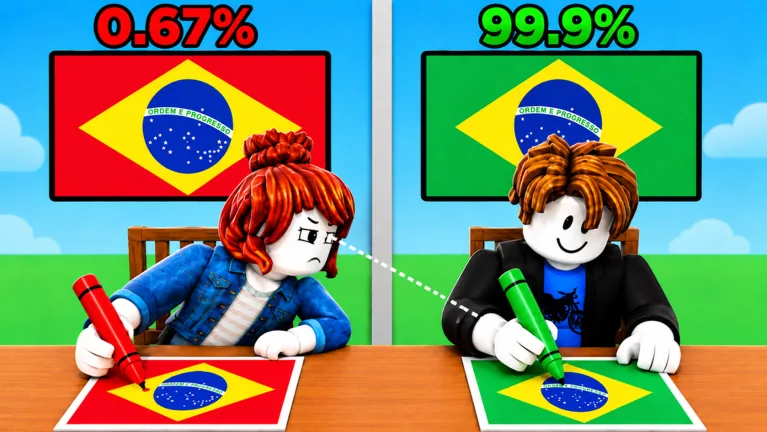
The official objective is higher accuracy. Results show separate percentage readouts for the competing flags, including decimal values. A broadly recognizable design can still receive less than a perfect result.
Check the current official rules before using a scoring equation to explain your result. Do not assume that the game checks every pixel, averages RGB differences, weights large regions more heavily or awards a speed bonus.
You can still improve without an equation. Recognition and a careful review give you decisions you can control, even when the exact scoring tolerance is unknown.
Review in a useful order
| Review question | Example problem | Next action |
|---|---|---|
| Is it the correct design? | Confusing England with the United Kingdom | Relearn the flag’s distinguishing shape |
| Are the colors in the right places? | Yellow above blue for Ukraine | Correct the arrangement |
| Did I miss a separate feature? | Forgetting Georgia’s small crosses | Inspect every symbol region |
| Does the selected shade match my intention? | A blue that looks purple | Adjust that color deliberately |
This order prevents you from polishing the wrong design. A slightly different green is a palette question; a red circle on a white background when the prompt is Bangladesh is a recognition question.
Use the Bangladesh guide and Georgia guide when those specific designs cause trouble.
Compare repeated attempts at the same flag
Keep the comparison narrow. If you encounter the same prompt again, preserve the parts you already understand and change the clearest error. A better result after one deliberate correction is useful feedback. A better result after changing everything leaves you unsure about what helped.
Do not treat scores from different countries as a clean comparison of your picker technique. Different designs create different recognition problems. A simple two-band flag and a split disc ask you to manage different arrangements, even before you choose shades.
For your own notes, record the flag name, the mistake you noticed and the change you want to try next. You do not need a complicated spreadsheet; a short reminder such as Greenland disc halves reversed is enough to give your next attempt a purpose.
Manage the countdown without inventing a speed rule
Watch the remaining time and reserve a final review. Choose an order you can follow calmly rather than cycling through every shade until the round ends.
Working on obvious parts first can help organize your attention. Check the current mode rules before assuming that those regions count more toward accuracy or that submitting earlier earns a bonus. Use the visible timer as a deadline for completing and checking your attempt, rather than treating speed as the scoring objective.
For color-control practice, read the picker guide. For the entire match routine, return to the beginner guide.
Do not chase a promise of 99.9%
A challenge title or another player’s successful result is not a guaranteed method. Copying the HEX value from a player’s attempt also does not prove that it is the game’s correct palette. Use national color descriptions to check the real-world design, then compare your attempts in the game separately.
Aim for a repeatable improvement you can explain. Recognizing the flag, correcting placement and learning one color adjustment gives you a useful skill for the next prompt, even when you do not reach a perfect percentage.
FAQ
Does Color My Flag publish its scoring formula?
Check the current official rules before trusting a scoring formula. The stated goal is higher accuracy; do not assume a comparison method, rounding rule or tie rule.
Why did a recognizable flag receive less than 100%?
A recognizable design does not establish an exact palette match. Recheck the arrangement and obvious color choices instead of assuming that recognition alone guarantees perfection.
Are larger areas worth more points?
Check the mode rules before assigning extra weight to a large region. Starting with a large field helps organize your attention; it does not provide a scoring exploit.
Is there a guaranteed way to reach 99.9%?
No method in this guide guarantees that result. Compare deliberate attempts at the same flag and correct an identifiable mistake before trusting a claimed perfect-color method.