Anchor the black band beside the flagpole
Belgium’s flag uses three vertical bands: black, yellow and red from the flagpole side toward the outer edge. In the usual flagpole-left display, black is left, yellow is central and red is right.
Start with black and read toward yellow, then red. Black distinguishes this palette from several other familiar tricolours. If you remember only yellow and red, it is easy to substitute another dark color or rotate the arrangement into horizontal bands.
Check the national layout on the Belgian government’s national-flags page. Use it to recognize the design, then check your selection in the game rather than treating the page as a color-code solution.
Use a side-to-side sequence
| Place in the design | Intended color | Mistake to catch |
|---|---|---|
| Hoist-side band | Black | Replacing it with blue |
| Central band | Yellow | Swapping it with red |
| Outer band | Red | Mirroring the whole sequence |
Read across the template. A top-to-bottom mental list is the wrong way to organize vertical bands, even when it contains the right color names.
The middle band is another useful anchor. Yellow sits between the two outside colors. If you have a yellow outside edge, check the arrangement before spending time on shade adjustments.
Separate a dark shade from the correct color family
Black and dark blue can look similar at a glance on a small canvas. Choose black deliberately rather than substituting blue because it looks dark enough. Name the color you want before judging its darkness.
Likewise, keep the central band yellow and the outer band red. Brightness changes cannot fix a swapped yellow-red pair. A vivid red in the middle is still in the wrong place for Belgium’s design.
Use the color picker guide if you are moving the wheel and tone control without a clear purpose. Select the intended family, inspect its application, and only then make a deliberate tone adjustment.
Catch rotation and mirroring as different errors
A horizontal black-yellow-red arrangement changes the orientation. A vertical red-yellow-black arrangement changes the direction. These errors can both preserve the palette, so a color-only check will miss them.
For orientation, check that each band runs from the top edge to the bottom edge. For direction, check which color touches the flagpole side. Inspect those properties separately even if the flag already looks striped.
The Ireland guide uses the same side-to-side checking direction, but its green-white-orange palette belongs to a different design. Learn the reading method without transferring the colors.
Finish with an outside-middle-outside scan
Before submitting, inspect black at the hoist, yellow in the middle and red at the far edge. Then look at the whole canvas once more to confirm that those are vertical regions.
If the order is right but you want a better result, keep the arrangement unchanged on a later Belgium attempt and adjust one selected color. That comparison is more useful than rotating the flag and changing several shades together.
Watch the countdown while following this sequence. It helps you remember which parts to inspect. Check the current mode rules before assuming any band receives extra accuracy weight or that early submission earns a bonus.
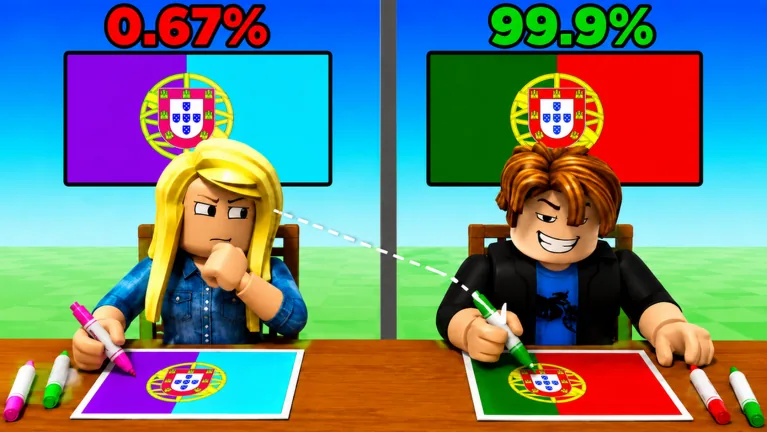
The gameplay clip below includes player attempts. Use the national design to check placement instead of treating every painted palette as a correct answer.
FAQ
What is Belgium’s color order?
Black, yellow and red from the flagpole side. With the flagpole side on the left, read that sequence left to right.
Are the bands vertical or horizontal?
Vertical. Each band runs from the top of the flag to the bottom.
Is the first band blue?
No. The intended national color is black. A dark appearance alone does not make blue interchangeable with it.
Can I use these color names as exact game codes?
No. They identify the national design, not an exact game HEX palette or a guaranteed percentage. Use the accuracy guide to review your attempts and compare deliberate color choices.